



5 Reasons Tin Is the Best Sustainable Packaging Material
Let's get the ball rolling straight.
Brand owners face two hard facts about packaging nowadays.
First, shoppers now check labels for planet-friendly claims almost as closely as they check prices.
Second, lawmakers from California to the EU are forcing companies to prove real recycling, not just green badges.
That puts pressure on every material, from flimsy pouches to heavy glass.
Tin-coated steel, what most people simply call “tin,” meets the new rules and the old ones too: protect the product, move easily through the supply chain, and hit brand budgets.
Below, we are going to discuss two big-picture themes and then further discuss five in-depth reasons tin stands out as the smartest pick for sustainable packaging materials across food, beauty, and beyond.
Packaging and the Planet: Why the Choice Matters?
The United States throws away more than 80 million tons of packaging each year. Half of it is plastic, and only the silver is recycled curbside. Metal cans, however, pass through magnet lines with ease and earn scrap yards real money. That built-in value keeps metal flowing back into the furnace instead of drifting into landfills or oceans.
A recent NIQ study found that 95 % of U.S. shoppers say they “try to live more sustainably,” with recycling and buying recyclable packs topping the list of actions they take.
When you move to tin, you get a clear claim buyers trust and regulators welcome. As a recyclable material, tin has a clear sustainability claim that is backed by consumer trust.
Consequently, brands seeking to align with eco-conscious values and regulatory standards should consider tin packaging.
5 Key Reasons Why Tin is the Best Choice Among Sustainable Packaging Materials?
In the global pursuit of sustainable packaging solutions, there are a number of choices available claiming to be eco-friendly. Each option presents a unique set of advantages and challenges.
However, due to the rise in demand for tins in industries and businesses, it has emerged as a top-rated green packaging choice. Its unique properties and accredited recycling nature make it a highly regarded alternative to other options like plastics and cardboard.
Now, we are going to discuss key reasons why tin stands out as the optimal eco-friendly metal packaging solution.
1 – Endless Recycling That Slashes Carbon
Steel belongs to the rare club of “permanent materials.” Atoms that form a soup can today can become car doors, bridge beams, or, yes, another soup can tomorrow.
The latest Can Manufacturers Institute white paper pegs the U.S. steel-can recycling rate at 62%, the highest of any food-grade pack. (Source: cancentral.com)
Each recycled ton:
Prevents about 1.5 tons of iron ore mining waste
Saves roughly 4.4 gigajoules of energy
Avoids nearly 2 metric tons of CO₂
Scrap demand is strong too. The U.S. melted 63 million tons of steel scrap in 2024, a slight rise over the previous year. That economic pull means towns and private companies chase cans rather than ignore them.
In contrast, flexible pouches mix plastic and aluminum layers; they’re light, but nobody wants them after use, so they head straight to landfill or incineration.
Recycling rules are tightening fast. California, Colorado, Maine, Oregon, and Minnesota have already passed Extended Producer Responsibility (EPR) laws for packaging. Under EPR, brands pay fees based on how easily their packs recycle. Steel earns the lowest tariff, further trimming costs.
With tin, you don’t just comply. You score a carbon win that investors and shoppers can measure.
2 – Rock-Solid Protection Cuts Breakage and Waste
Product spoilage is the hidden footprint. When a pouch tears or a glass jar cracks, the lost food counts as wasted water, fertilizer, freight fuel, and labor. Tin’s rigid walls and double-seamed lids stop that domino effect.
Logistics upside
Stack height: Pallets can often double in warehouse racks because tin cans resist crushing.
Freight fill: Cylindrical or rectangular cans leave minimal voids, raising truck utilization by up to 15 %.E-commerce resiliency: Drop-tests at 1.2 meters, a typical conveyor fall, show less than 0.5 % dent depth on standard food cans versus 12 % crack incidence in PET jars.
Shelf-life boost
The all-metal shell blocks UV that bleaches vitamins and kills color, while seams hold oxygen below 0.1%. A 2023 Journal of Food Engineering study found food waste fell by one-third when tomato sauce moved from stand-up pouches to steel cans (longer ambient life and fewer shipping leaks).
Real-world data
Gnarly Sports Nutrition: Switched to tin cans from plastic bottles for supplements, cutting plastic waste. (Source)
Waitrose: This brand tried loose tins over plastic-wrapped multibuy cans, saving 18 tonnes of plastic yearly.
Carlsberg: Replaced plastic six-pack rings with glue for tin cans, eliminating 1,200 tons of plastic annually.
LICKALIX: Moved to compostable wrappers and tin cans for popsicles, reducing plastic waste.
Tesco (Loop Trial): Used reusable tin cans for brands like Heinz, reducing single-use plastic waste. (Source)
3 – Safety and Nutrition Consumers Can Taste
Tin packaging for food offers a defensive line against every major spoilage vector: light, air, moisture, and microbes.
Retort-ready
Cans tolerate 121 °C (250 °F) at 15 psi for over half an hour, the gold-standard thermal kill step. Because the food heats inside the pack, there is zero chance of post-process contamination.
Liner science
Modern cans use BPA-free epoxy, polyester, or acrylic liners, each chosen to suit the fill:
Acid foods (tomato, fruit) → modified polyester
Fatty foods (coconut milk) → BPA-ni epoxy
Sulfur-rich foods (corned beef) → sulfur-resistant oleoresin.
These coatings measure just a few microns, so they don’t hinder recycling.
Nutrient retention
Studies show canned sweetcorn retains over 85% of its beta-carotene after two years in storage, better than frozen corn stored for eight months with multiple thaw cycles. The absence of oxygen is key. Vitamin C losses in canned peaches are half those in PET jars over the same period.
Allergen control
It is more common for steel cans to run on dedicated lines than flexible laminates that share lines with dairy products or nuts. As a result of the hot water and caustic soda used in wash-downs, stainless processing equipment is not at risk of cross-contact with allergens.
Safety sells. Parents buying infant formula or athletes shopping for protein shakes place trust above all else. Tin helps you earn that trust, then back it with hard science.
4 – A Clear Sustainability Story Buyers Understand
Consumers are swamped with eco claims, yet many of them are confusing. It may take months for a biodegradable material to decompose in an industrial digester. There is no guarantee that "plant-based" will mean landfill-based.
Tin’s story is easier: magnets pull it out, mills pay for it, and it re-enters the market as new steel.
Data from Packaging Digest shows trust in sustainability claims climbs to 69% when brands give simple, verifiable information.
That’s exactly what steel offers:
Proof in action: Anyone can test a soup can with a simple magnet.
Visible sorting: Recycling centres often let school tours watch the massive overhead magnets at work, free brand education.
Cash loop: Scrap value turns consumer drop-off into a revenue stream for communities, not a cost.
Having a story that buyers understand, the law embraces, and the finance team acclaims is a rare triple win.
5 - Design Freedom and Brand Value
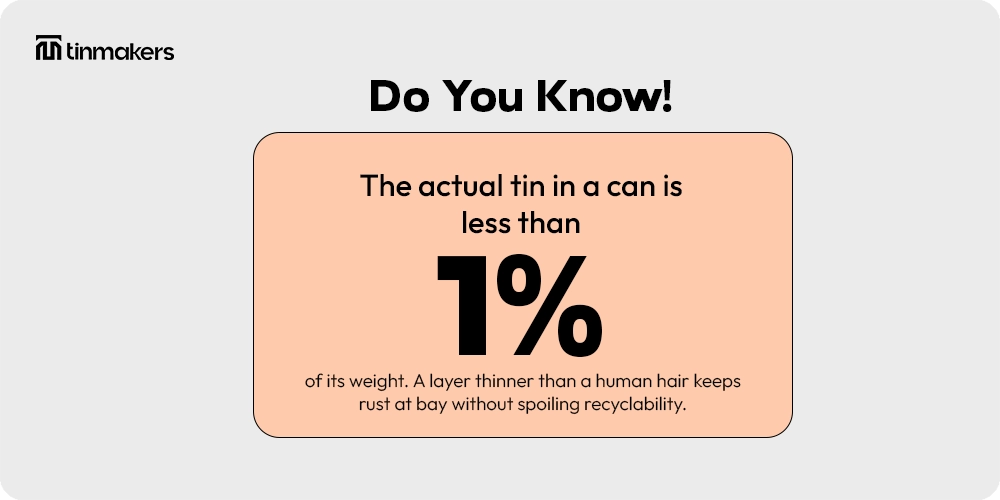
Who can undervalue the design freedom in tin boxes as it allows for customization and enables them to be reused for various purposes. Metal gives you a studio-grade canvas without the fragile nature of glass.
Print power
Lithographic presses lay photo-quality graphics on flat sheets before forming on these printed tin boxes. The ink fuses under heat, so labels can’t peel like stickers. You can add matte varnish, spot gloss, or even glow-in-the-dark ink for seasonal runs.
Shaping options
Round soup cans are only the beginning. Modern presses crank out:
Slide-top mint tins
Heart-shaped candle shells
Slimline aerosol sleeves
Tooling costs have fallen sharply with digital die-making. Minimum orders as low as 3,000 let start-ups test new SKUs without risky inventory.
Emboss & deboss
Raised logos or recessed frames add tactile cues in tin boxes. Shoppers running fingers over embossed art form a subconscious premium signal. One study showed a 22 % higher perceived value for embossed tins over flat-printed PET tubs in blind shelf tests.
Interactive packs
Metal is conductive, making it easy to hide NFC tags under a print layer. Scan-for-story campaigns can reveal recipe videos, loyalty points, or AR filters without affecting curbside recycling.
Long life, long ad
A well-designed tin earns a second life as a pencil cup, spice box, or sewing kit. That keeps your logo on desks and kitchen shelves long after the product is eaten, free impressions every day.
In short, the advantages of tin cans extend from line efficiency to brand storytelling, turning a cost center into a marketing asset.
Final Thoughts
Tin-coated steel is more than yesterday’s ordinary can. It’s a forward-looking product that cuts carbon, guards flavor, trims breakage, and lets designers stretch their imaginations.
Laws already favor it; shoppers already trust it. When you weigh the upfront pennies against the lifetime gains, lower damage claims, easier recycling fees, added shelf punch, tin often wins both on the spreadsheet and the planet scorecard.
Schedule a test run, track the data, and share the results. Your customers, your finance team, and Earth will all notice the difference. Turn to Tin Makers now for affordable and sustainable tin packaging solutions.
FAQs
Is tin safe for acidic foods like tomatoes?
Yes. Cans use BPA-free epoxy or polyester linings that stop any metal taste or reaction. Tomato paste, pickles, and citrus segments are packed in tin around the world without issues.
How many times can steel be recycled?
Tin boxes can be recycled indefinitely without losing quality. Melting and rolling do not weaken its structure, so atoms can cycle through the furnace again and again without losing strength.
Does tin add a metallic flavor?
No. The food-safe liner prevents contact between the product and metal. Sensory panels show no taste difference versus glass controls.
How does tin compare with plastic in weight?
A 400 ml steel can weighs about 40 g, while a PET jar of the same volume weighs roughly 25 g. The extra grams buy far higher strength and recyclability.
Are tin cans compatible with QR codes or NFC tags?
Absolutely. High-resolution QR codes print directly on metal; thin NFC stickers hide under the art without affecting recycling.

Liam George Freeman
Liam George Freeman is a seasoned expert in the packaging industry, with a focus on delivering sharp, in-depth contributions that resonate with readers. His deep understanding of tin packaging and its expansion, the diverse types, and global impact, including its role in NASDAQ markets, makes him a true gem of a writer. Liam brings clarity and authenticity to every piece. When he’s not crafting compelling insights for the writer's desk, he will likely be found strategizing over a chessboard, always up for a thoughtful match.





Copyright © 2026 tinmakers. All rights reserved